Monday, April 13, 2009
Its gardening season!
Again I must apologize for the lack of posting but that last month has been pretty much nothing but weeding and watering with nothing of interest to report. But things are starting to pick up around this Atlanta (rented) homestead. This weekend marked the special date of April 10th, supposedly the last frost date for Atlanta. As a celebration (I hope) I decided to plant all my seedlings that I've been cultivating in my basement under grow lights. Of course the plan was to use only a small section of the garden bed for those seedling which, of course, proved to be totally unrealistic. I am never going to trust my judgment of space needs in the garden again as the peppers and half the tomatoes I'd started took up most of an 8'x4' garden bed (minus the space for some lettuce). Luckily for my neighbor I ended up with a few spare pepper plants that I donated to their garden in exchange for a ride to the big box store for the supplies to build a 4th (and hopefully final) garden bed. So far things are good with the transplanted seedlings, I can only hope it continues.

Wednesday, March 18, 2009
A Garden Update
Appoligies for the lax posting schedule as of late, I've been swamped with work and haven't had as much time for blogging as I would like. February 28th was a beautful Saturday and despite knowing that the last projected frost for Atlanta is the 10th of April I decided to temp the weather gods and plant some seeds anyway. It turned out that I had plenty of cold hardy seeds that suggested planting several weeks before the last frost and these are what I concentrated on planting. I was aiming at filling up at least one of the beds with plants and leaving the second bed for planting my seedlings and some other seeds after the last frost.


 Luckily the snow seems to have had little effect on the ability of the seeds to grow into small seedlings. Everything has started to sprout (although the carrots seem to be slow in their emergence) and my only fear has been the robins that like to root around in the beds looking for the nice worms that live there. The red onions that my neighbors gave me also seem to be doing just fine despite their brush with the crazy Atlanta weather. My biggest problem now has become weeding. The choice to mix dirt from my backyard with store bought soil means that I have a decent amount of weeds growing in the beds. Generally these are easy to pick out since they grow between the rows and I've learned to identify which little green things sticking out of the ground are the little green things I want to cultivate and which ones I want to pick out of the way, but at first it was a difficult job. I found my self very hesitant to pick anything out lest it actually be something I want to grow, but with some courage and help from google I've pretty much got a handle on what stays and what goes.
Unfortunately I underestimated the amount of spacing that there needs to be in a garden bed. Sure I can plant closely in a row (I tried to maintain about an inch between seeds but generally failed at that) but when your beds are only four feet wide the six inches to a foot spacing between rows will quickly use up all the space. I am still surprised at my inability to judge the dimensions required for everything I'm doing. At first I thought 8'x4'x8" sounded like a small amount of dirt needed, until I actually went to fill it in. After becoming accostomed to the size of my beds I grossly overestimated the amount of plants I could squeeze into each bed. I wonder now if this is a common problem for humans, or just specific to me.
In the end I filled up both my beds with seeds, including a patch of red onions that were already several inches tall that my neighbors graciously offered me. Also planted was: spinach, arugula, rabini broccoli, mustard greens, several varieties of carrots, swiss chard, yellow onions and some leeks.
Unfortunately I failed to take account for the weather forcast of snow for the next day. Snow? Atlanta? Hah! Who thinks it could possibly snow in Atlanta in March? Whoops!
That was just the beginning. By the end of the day I had several inches of snow on top of the beds that stayed for almost two days.
Luckily the snow seems to have had little effect on the ability of the seeds to grow into small seedlings. Everything has started to sprout (although the carrots seem to be slow in their emergence) and my only fear has been the robins that like to root around in the beds looking for the nice worms that live there. The red onions that my neighbors gave me also seem to be doing just fine despite their brush with the crazy Atlanta weather. My biggest problem now has become weeding. The choice to mix dirt from my backyard with store bought soil means that I have a decent amount of weeds growing in the beds. Generally these are easy to pick out since they grow between the rows and I've learned to identify which little green things sticking out of the ground are the little green things I want to cultivate and which ones I want to pick out of the way, but at first it was a difficult job. I found my self very hesitant to pick anything out lest it actually be something I want to grow, but with some courage and help from google I've pretty much got a handle on what stays and what goes.I've also made some improvements to the garden. After filling out the two original beds I decided that I should expand with a third bed of the same design. The only differences between this new bed and the two originals is the addition of a cardboard bottom. Due to space considerations I had to place this bed directly over a kudzu tuber. I cut the tuber down as far as I could into the ground but have little hope that this will dissuade the plant from coming back up (supposedly their roots can be 15 feet deep). I decided that a thick cardboard bottom will help at least direct the kudzu to grow sideways where I can keep hacking at it and hopefully not have it destroy whatever I plant in this bed. I also abandoned the idea of mixing some dirt from the backyard with the dirt in the 3rd bed, mostly because I didn't want to dig another hole in the backyard. Instead I mixed in an extra giant brick of peat moss to help fill out the bed. The latest thing I've done is adding a layer of mulch around the outsides of the beds. Already this has kept my pants cleaner since I'm not leaning on the grass and I'm hoping it will keep the grass from growing so much around the outside of the beds so I don't have to mow as much.
Look forward to more regular updates in the future as things start really getting busy. Its only three weeks till the last frost date and hopefully I can wait till then to start a whole new slew of seeds/seedlings.
Thursday, February 26, 2009
More Seeds

The seeds I ordered from Victory Seed Company finally arrived yesterday. All in all I was fairly satisfied with the experience, they have a great selection of heirloom vegetables and the packaging is nice with the seeds being packaged in a small baggie inside the normal paper pouch. Shipping took quite a while, however. It took nearly two weeks for the envelope of seeds to get to my mailbox from the time I put the order in on the website. Mostly I think thats an indication of how spoiled I've become by companies like Amazon that are ready to ship any item at any time.
The garden challenges this just-in-time expectation though. I still find myself checking on the seedings that I have planted every few hours to see if something new has happened to them, much like I spasticly click on my inbox or refresh a shipping status to see if anything has happened that I simply must know about at this exact moment. Plants, however, don't care about my impatience. They are going to germinate and sprout in their own good time and there isn't much I can do to hurry things along. Constantly asking the plant "Are you ready yet?" seems fairly counterproductive. Poking at the seedling to see if it's grown its first real leaves, digging at an onion to see if its bulb is big enough to eat are not going to make things go faster, but they might just make things fail all together. The best approach seems to be to know the plant. This doesn't necessarily mean to know the parameters of growth with charts, my broccoli seeds were supposed to take 10-15 days to germinate according to the package but took less than a week. What you have to do is understand what the plant is saying to you in its special plant language of color and size, and the only way to listen seems to be patience.
Saturday, February 14, 2009
More on Starting Seeds
 Its been a few days since I first began starting seeds for the garden and I'm happy to say that they have already started to pop their heads out of the ground. If you click the image you can see the little green sprouts of broccoli and red onions starting to appear.
I've also gotten my first help with the garden. My friend K came over and helped out with the adding of some extra peat moss to the beds. We followed that up with the comparison of seed purchases and then enjoying some homemade BBQ. In the end I agreed to try and start some cabbage and leeks for the both of us which will find a home in one of the raised beds eventually.
Its been a post or two (I think) since I waxed philosophic about what it is I'm doing and I think this last meeting has some interesting parallels. BBQ and gardening have a great deal in common. Both take quite a chunk of time out of your day and both take a lot longer to do yourself than to pay someone else to do it for you. There are definitely people out there who are better at growing vegetables than I am and its a hell of a lot easier to go to the supermarket or even the farmers market and buy leeks or cabbage from them, just like its easier for me to walk down the street to the BBQ shack that makes some of the best ribs in Atlanta. But there is more to gardening and smoking meat than just the enjoyment of the end product.
Most obviously the end product that is produced is wholly yours. I may make mediocre to poor BBQ at times but damn it its MY BBQ, every time I smoke ribs they turn out slightly different and that difference is a change that I made. The same can be said for my garden. If I choose to plant cabbage in the same place I planted cabbage in the past two years and I get some horrible cabbage disease I know what caused it and I can appreciate my agency in the whole affair. This adds to the enjoyment of the finished product. I certainly enjoy my own ribs more than the far superior ribs from the shack down the street because I know the story of the ribs I'm eating.
Another benefit to growing your own vegetables and smoking your meat is the process. The whole act of growing vegetables or smoking meat is pleasurable and satisfying. While I'm digging in the garden or planting seeds I get to look at what I'm doing and appreciate the future consequences (the future is always rosy when gardening I've found). The same is true for smoking meat, or even cooking in general, just watching the changes take place in the food makes me anticipate that final moment more and, I imagine, makes the final product taste that much better. Process also has its own pleasures. I can't really garden while I'm doing contract work or watching TV. I have to go out to my garden, or sit in my kitchen with my seeds and work in the dirt. I have to take time and do some manual labor away from technology. In the garden there is no instant messaging or websites to distract, only the dirt and the occasional worm running away from your hoeing. As a programmer I find the lack of technology incredibly peaceful and I now find myself wishing I was digging in some dirt while I'm working.
The last frost for Atlanta (according to NOAA) is on April 10th, which means that the end of March marks the real beginning of gardening here. I'm itching to have whole days dedicated to working in the back yard with friends and a beer, having some ribs in the smoker and participating in some of the oldest arts that humanity knows.
Monday, February 9, 2009
Starting Seeds
Yesterday I began starting the first seeds for the garden. I only had the supplies from the big box store that were worth about 25 plants and some clearance from the local East Atlanta Ace Hardware (I know that Ace is a chain but the East Atlanta Ace has the single best customer service of any business I've ever been to, if you leave anywhere near East Atlanta or the Virginia Highlands I recommend Ace over a big box any day of the week). In all I had enough soil and pots to start 55 plants. I choose things for several criteria. The most important was when they could stand the weather. It wouldn't make much sense to start cucumbers, for example, in February for an early April planting since they won't grow well until the summer. Another key factor was the time it takes to germinate. Peppers, it turns out, take AT LEAST 8 weeks before they are ready to transplant into the ground. For those I'm already late. Another key factor was likability. I'm hoping that my roommate will get interested in the garden to help with planting, watering, weeding and buying supplies. Therefore I made sure to plant things that I know he would be sure to be interested in, mainly hot peppers.
In the end I've started seeds for Serrano Peppers, Cascabella Peppers, Red Amposta onions, Rosemary and a Hybrid Broccoli. I've started 10 pots for each (except the rosemary which only got 5). I've also ordered a grow light to help the little seedlings out when they sprout. If this has tought me one thing so far its patience. It will be at least a week before any of these seeds germinate, but I've already found myself checking on their moisture every few hours. I'm already planning on starting more seeds sometime soon and hopefully at the end of February I'll get my chance to plant some Lettuce and Spinach seeds in the actual beds. The last projected frost for Atlanta is April 10th and I'm counting down the days!
In the end I've started seeds for Serrano Peppers, Cascabella Peppers, Red Amposta onions, Rosemary and a Hybrid Broccoli. I've started 10 pots for each (except the rosemary which only got 5). I've also ordered a grow light to help the little seedlings out when they sprout. If this has tought me one thing so far its patience. It will be at least a week before any of these seeds germinate, but I've already found myself checking on their moisture every few hours. I'm already planning on starting more seeds sometime soon and hopefully at the end of February I'll get my chance to plant some Lettuce and Spinach seeds in the actual beds. The last projected frost for Atlanta is April 10th and I'm counting down the days!
Thursday, February 5, 2009
Building Some Soil
One of the best things (and worst things) about putting in raised beds is that you get to make your own soil. At first I had dreams of simply going to the store and buying enough good topsoil to fill my beds up. This quickly ended when I went to the big box store to buy the wood for the beds and the bags of soil. I have memories of my father gardening back in the day and coming back with huge bags of rich black soil that filled up our garden beds so that we could plant roses or peppers and figured that I could only need a few bags to fill up my beds right? Of course it turns out that like so many memories of things from the early 90s and late 80s the bags of soil had mysteriously shrank, or more likely my scale of reference has change greatly since I was three feet tall.
By my calculations each of my raised beds was 4'x8'x8" or 4'x8'x0.666' which using my geometry know-how is 31 cubic feet per bed. That didn't sound too bad until I found the soil at the big box store. Each bag was at most 2 cubic feet and for organic soil cost about $7 a bag or about $217 to fill both my beds. Financial panic set in.
Luckily I also read the back of a few of the bags that mentioned mixing with the local soil in a 1:1 ratio. Seeing as I was slightly underemployed at the moment this made me feel much better. I could invest time into digging up some of the soil in my back yard and transplant it into the raised beds where it could do more useful things than grow kudzu and grass. I decided that 3 bags of soil (or 6 cubic feet) would be plenty if mixed with a little more than a 1:1 ratio of soil and leaving an inch or two of extra space in the bed for mulch or a later dosage of soil If I felt like it. In the end all the soil still cost around $42 and was easily the most expensive part of building the two beds (which came out around $111 total).
To prepare the area I first went about cutting the grass around where I was going to be placing the beds. This is where I ran into my first issue, kudzu. The kudzu may not be green this time of year but the vines are still all over hiding under the top layer of grass. In the end I must have pulled up over a hundred feet of kudzu vine, hopefully this will make it easier to manage the kudzu come springtime. I then broke my first ground, digging four holes to set the footers for the bed frames into. Once these were in place I took my shovel and broke up the sod slightly (not enough to turn over the soil, just enough to put holes in the sod and make it easier for plants to grow through the sod) and began the process of filling the beds.
My main goal was to make the transition for any deeply rooting plants from rich soil to true Georgia soil as easy as possible. Therefore I started with a layer of dirt (probably more accurately described as clay) over the sod. Once I had the sod covered in a good inch deep layer I began to put in the store bought soil.

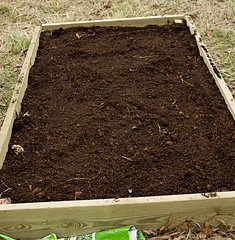
Once I had emptied the bag of soil I put in several more buckets of local soil, mixing the two together as thoroughly as I could. Repeating until I had used all three bags of soil, which ended up looking something like this:
Once I was satisfied with the fill level of the bed I decided a layer of mulch was in order to help protect against the tons of weed seeds I had undoubtedly dug up (along with the countless earthworms I had also put into the bed!) Instead of buying anything I went with the one resource my yard has plenty of: leaves.

Of course the next day we got a huge windstorm in Atlanta which has blown most of my mulch away, but there is plenty more where that came from.
One of the most satisfying things about filling the beds was the smells that come from the bagged soil and the freshly dug dirt. Both brought back some great memories from my childhood. The bagged soil brought back memories of assisting (under duress of course) my mother and father in the planting of roses and other landscaping over the years. I forgot how good the smell of compost really is. Its rich and loamy and the smell itself brings forth thoughts of things growing and sprouting. The dirt that I dug out of the yard also brought old memories forward. Mostly childhood digging and playing. Either way I hope those are the smells of productive soil.
By my calculations each of my raised beds was 4'x8'x8" or 4'x8'x0.666' which using my geometry know-how is 31 cubic feet per bed. That didn't sound too bad until I found the soil at the big box store. Each bag was at most 2 cubic feet and for organic soil cost about $7 a bag or about $217 to fill both my beds. Financial panic set in.
Luckily I also read the back of a few of the bags that mentioned mixing with the local soil in a 1:1 ratio. Seeing as I was slightly underemployed at the moment this made me feel much better. I could invest time into digging up some of the soil in my back yard and transplant it into the raised beds where it could do more useful things than grow kudzu and grass. I decided that 3 bags of soil (or 6 cubic feet) would be plenty if mixed with a little more than a 1:1 ratio of soil and leaving an inch or two of extra space in the bed for mulch or a later dosage of soil If I felt like it. In the end all the soil still cost around $42 and was easily the most expensive part of building the two beds (which came out around $111 total).
To prepare the area I first went about cutting the grass around where I was going to be placing the beds. This is where I ran into my first issue, kudzu. The kudzu may not be green this time of year but the vines are still all over hiding under the top layer of grass. In the end I must have pulled up over a hundred feet of kudzu vine, hopefully this will make it easier to manage the kudzu come springtime. I then broke my first ground, digging four holes to set the footers for the bed frames into. Once these were in place I took my shovel and broke up the sod slightly (not enough to turn over the soil, just enough to put holes in the sod and make it easier for plants to grow through the sod) and began the process of filling the beds.
My main goal was to make the transition for any deeply rooting plants from rich soil to true Georgia soil as easy as possible. Therefore I started with a layer of dirt (probably more accurately described as clay) over the sod. Once I had the sod covered in a good inch deep layer I began to put in the store bought soil.
Once I had emptied the bag of soil I put in several more buckets of local soil, mixing the two together as thoroughly as I could. Repeating until I had used all three bags of soil, which ended up looking something like this:
Once I was satisfied with the fill level of the bed I decided a layer of mulch was in order to help protect against the tons of weed seeds I had undoubtedly dug up (along with the countless earthworms I had also put into the bed!) Instead of buying anything I went with the one resource my yard has plenty of: leaves.
Of course the next day we got a huge windstorm in Atlanta which has blown most of my mulch away, but there is plenty more where that came from.
One of the most satisfying things about filling the beds was the smells that come from the bagged soil and the freshly dug dirt. Both brought back some great memories from my childhood. The bagged soil brought back memories of assisting (under duress of course) my mother and father in the planting of roses and other landscaping over the years. I forgot how good the smell of compost really is. Its rich and loamy and the smell itself brings forth thoughts of things growing and sprouting. The dirt that I dug out of the yard also brought old memories forward. Mostly childhood digging and playing. Either way I hope those are the smells of productive soil.
Sunday, February 1, 2009
Building Some Raised Beds
This weekend was absolutely beautiful in Atlanta, mid to low sixties and not a cloud in the sky! A perfect time to get some work done in the (soon to be) garden. On Saturday I finally took my neighbors' (Damon and Diana) invitation to come over and check out their small backyard garden. Their setup is quite simple, a few small beds planted right in the ground and surrounded by some bricks or boards. Damon mentioned that he really wanted to expand, but since they now have two young kids they really didn't have time, I have a feeling once their oldest gets a little older they may put him to work making some food. The best part of the visit was the information I got out of Damon. Nothing genius really but lots of good insights on shadows from the house (both our houses face south and so we have long shadows in our backyard right now. In the summer, however, the sun won't put anywhere near as big a shadow on the yards and we have more space to garden in). Diana also had some pointers on some edible wild plants that grow near here and was also incredibly excited about possibly sharing a chicken coup if I decided to do that. Having neighbors who garden is a great boon for me. I don't have much experience in the garden, having only tended the peppers in the garden when I was maybe nine or ten, and to have people who can help answer questions is great. It also helps that our gardens are right next to each other so they have experience with the local conditions. More proof that gardens build community!
Saturday was also the day to pick up all the supplies for my big project of the weekend, building some raised garden beds. I was basing my design on the design found in "The Urban Homestead." Its simply a wooden perimeter that holds in some dirt on top of the ground. On the plus side this helps keep down weeds, cuts down on the amount of digging into the tough Georgia clay and lets you design your soil. On the downside it means I have to use my (very rusty) carpentry skills and pay for the lumber.
The process for building these was pretty simple. I started off with a bunch of lumber, to be exact a single 4"x4"x6' piece of lumber and six 2"x8"x8' boards.

The original plans had this being made into one bed that was 16" tall. After talking with Damon over the fence we decided that I didn't really need all of that height if I was going to be using a mixture of local and store bought dirt since I could break up the ground under the bed and the plants could grow into that. I then cut two of the 2x8s into two 4' pieces for the end. The 4x4 I cut into 8 equal pieces that were 9" long.

Now its just a matter of putting the things together. The first bed I started by screwing the long sides onto the 4x4s first (drilling pilot holes first).

Saturday was also the day to pick up all the supplies for my big project of the weekend, building some raised garden beds. I was basing my design on the design found in "The Urban Homestead." Its simply a wooden perimeter that holds in some dirt on top of the ground. On the plus side this helps keep down weeds, cuts down on the amount of digging into the tough Georgia clay and lets you design your soil. On the downside it means I have to use my (very rusty) carpentry skills and pay for the lumber.
The process for building these was pretty simple. I started off with a bunch of lumber, to be exact a single 4"x4"x6' piece of lumber and six 2"x8"x8' boards.
The original plans had this being made into one bed that was 16" tall. After talking with Damon over the fence we decided that I didn't really need all of that height if I was going to be using a mixture of local and store bought dirt since I could break up the ground under the bed and the plants could grow into that. I then cut two of the 2x8s into two 4' pieces for the end. The 4x4 I cut into 8 equal pieces that were 9" long.
Now its just a matter of putting the things together. The first bed I started by screwing the long sides onto the 4x4s first (drilling pilot holes first).
I then tried to put the short ends on the long ends to complete the bed and ran into some trouble. First off I discovered its hard to get enough pressure on the drill the screw 3" screws into pressure treated lumber by pushing sideways and I couldn't stand the bed on its end because I'm only 6' tall. Eventually, with a little twisting of

Unfortunately at this point I had to run back to the store to get more screws. I got the second bed about 3/4 of the way done before I gave up on account of lack of daylight. Building these I learned some important things:
1) Lumber is heavy
2) The corded drill Travis has sucks
3) A 4'x8' bed is going to need a lot of dirt
4) 8x2 = 16 < 20 which is how many screws there are in a package.
Some time this week I'm hoping to cut down some of the tall grass in the backyard where I want to put these then work on building the soil for them. I'm planning on a mixture of the local dirt from under the kudzu (I hear that the kudzu really helps the soil) and some of the organic soil I picked up from the big box store. After that I'm going to put a layer of mulch (that is, dead leaves) over the whole thing and start getting ready for the growing season.
Unfortunately at this point I had to run back to the store to get more screws. I got the second bed about 3/4 of the way done before I gave up on account of lack of daylight. Building these I learned some important things:
1) Lumber is heavy
2) The corded drill Travis has sucks
3) A 4'x8' bed is going to need a lot of dirt
4) 8x2 = 16 < 20 which is how many screws there are in a package.
Some time this week I'm hoping to cut down some of the tall grass in the backyard where I want to put these then work on building the soil for them. I'm planning on a mixture of the local dirt from under the kudzu (I hear that the kudzu really helps the soil) and some of the organic soil I picked up from the big box store. After that I'm going to put a layer of mulch (that is, dead leaves) over the whole thing and start getting ready for the growing season.
Subscribe to:
Posts (Atom)
